top of page


Home Consoles
Atari 2600 (1977)
Originally released in 1977 as the Atari Video Computer System (VCS), later renamed to the 2600 following the release of the Atari 5200, the Atari 2600 popularised interchangeable video game cartridges (a feature first introduced with the Fairchild Channel F). The Atari 2600's success was largely due to its incredible wide library of arcade game ports to the system due to many arcade games such as Asteroids and Centipede being developed and owned by Atari, as well as gaining licenses from Japanese developers Taito and Namco to produce 2600 ports of their games such as Space Invaders and Pac-Man.

While the Atari 2600 is widely blamed for the the video game market crash of 1983, the causes for the crash are far more complex and varied, with Atari being only one player in a much wider market that had a multitude of problems and challenges.
NES (1985)
Released in October of 1985 by Nintendo, the Nintendo Entertainment System (NES) was Nintendo's first major home console, previously only making all-in-one plug and play devices with limited built in game selections.
The NES was made to be an affordable home console that had the ability to run arcade quality games from cartridges. The NES is one of the most important consoles of all time, often credited with reviving the industry after the video game crash of 1983 that had virtually destroyed the home video game market in the USA.

The NES was originally released in Japan in 1983 as the 'Family Computer' or 'Famicom' with an entirely different design. The re-design was intended to resemble a VCR in order to appeal to audiences who may be weary of video game consoles after the 1983 video game crash.
Mega Drive (1988)
Originally released in October of 1988 by Sega in Japan, the Mega Drive was released to compete with the recently released PC Engine, a 16-bit home console by Japanese computer giants Hudson Soft and NEC, as well as the Famicom/NES from Nintendo, who would not introduce their own 16-bit system until 1990.
The Sega Mega Drive was marketed as a 'cooler' alternative to the family friendly Famicom by Nintendo and would be the introduction of Sonic the Hedgehog, Sega's mascot and 'edgier' rival to Nintendo's Mario.
Sega would release various add-ons for the Mega Drive, including the Sega CD and LaserActive, which could play compact disc and laser disc based games.
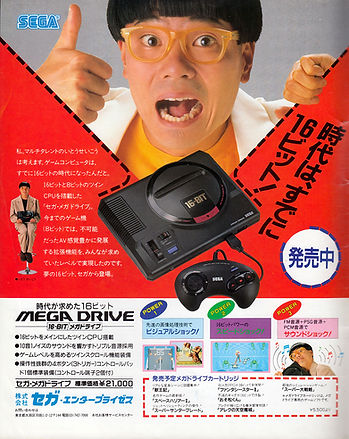
The Mega Drive was sold in North America as the Sega Genesis and was advertised with the famous slogan ''Genesis does what Nintendon't'' highlighting the more advanced nature of Sega's offering, as at the time of release, Nintendo would not introduce their own 16-bit console in North America for another two years.
SNES (1991)
Released in August of 1991 by Nintendo, the Super Nintendo Entertainment System (SNES), was Nintendo's 16-bit home console offering and main competitor to Sega's Mega Drive. The competition between Sega and Nintendo during this time is considered one of the most notable console wars in history. Even though the SNES was a latecomer to the 16-bit generation of consoles and faced harsh competition from the Sega Mega Drive, the SNES would still end up becoming the best selling console of its generation.

The SNES like the NES before it was sold in Japan under the 'Super Famicom' name. The console's exterior was re-designed for the North American market, while the European version remained nearly identical to the Japanese version just with a the different name and some colour changes.
bottom of page